Yu Sleep Ingredients: What Each One Does and What the Science Says
Yu Sleep contains six active ingredients. Below we explain where each one comes from, how it is thought to affect sleep, what human studies have found, and what to watch out for, so you can judge the formula for yourself.
Yu Sleeps is independent and is not the manufacturer of Yu Sleep. We may earn a commission if you buy through our links. This page is for information only and is not medical advice. How we're funded
The Full Yu Sleep Ingredient List
According to the manufacturer, each serving of Yu Sleep contains melatonin, L-theanine, tart cherry extract, 5-HTP, GABA, and vitamins B6 and B12. Together they target two things: the timing of sleep, and the mental tension that keeps people awake.
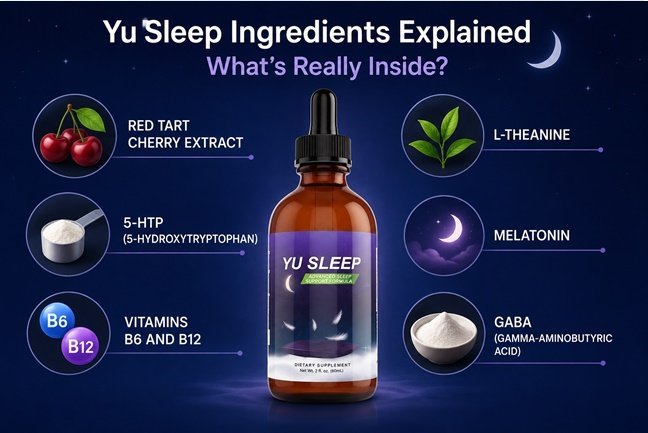
The ingredients fall into three groups. Sleep-timing ingredients (melatonin and tart cherry) tell your body clock that night has arrived. Calming ingredients (L-theanine and GABA) aim to quiet a busy mind. Building blocks (5-HTP, B6 and B12) support the body's own production of serotonin, which it later converts into melatonin.
Melatonin
What it is. Melatonin is a hormone made by the pineal gland in your brain. Levels rise in the evening as light fades and fall in the morning. Supplement melatonin is usually made in a lab and is chemically identical to the body's own.
How it works. Melatonin doesn't knock you out like a sedative. It acts more like a signal, telling the body clock that it is night. That's why it is most helpful when your clock is out of sync, for example after flying across time zones, when your bedtime has drifted late, or when you work shifts.
What the research says. Melatonin is one of the most studied sleep supplements. Reviews of clinical trials show it helps with jet lag and delayed sleep schedules, and gives a modest improvement in how quickly people fall asleep. Studies also suggest that low doses, often 0.5 to 3 mg, can work as well as higher ones.
Watch out for. Headaches, dizziness, vivid dreams and morning drowsiness, especially at higher doses.
L-Theanine
What it is. An amino acid found mainly in tea leaves. It is one reason green tea can feel calming despite its caffeine.
How it works. L-theanine is thought to encourage relaxed, alert brain activity and to influence calming brain chemicals. The goal is to ease stress and racing thoughts rather than to sedate.
What the research says. Several small randomized trials found that L-theanine, usually at 200 to 400 mg a day, improved self-reported sleep quality and reduced stress. The studies are small, but results are fairly consistent, which makes it one of the better-supported natural options for people who lie awake thinking.
Watch out for. It is generally well tolerated. It may add to the effect of blood pressure medication or sedatives.
Tart Cherry Extract
What it is. Extract of tart cherries, usually the Montmorency variety, which contain small amounts of natural melatonin and plant compounds called polyphenols.
How it works. Beyond its small melatonin content, tart cherry may help the body make more of its own melatonin, and its polyphenols have anti-inflammatory effects.
What the research says. A handful of small studies, mostly using tart cherry juice twice a day, reported longer sleep and better sleep efficiency, including in older adults with insomnia. Most studies used juice or concentrate, so it's hard to say how much a small amount of extract adds to a formula that already contains melatonin.
Watch out for. Very few side effects in normal amounts.
5-HTP (5-Hydroxytryptophan)
What it is. A compound the body makes from the amino acid tryptophan. Supplements are usually extracted from the seeds of the African plant Griffonia simplicifolia.
How it works. The body converts 5-HTP into serotonin, and serotonin into melatonin. In theory, more 5-HTP could mean more of both.
What the research says. Most research on 5-HTP looks at mood rather than sleep, and direct evidence that it improves sleep is limited.
Watch out for. This is the most important safety point in the formula. Combined with antidepressants or other drugs that raise serotonin, 5-HTP can contribute to serotonin syndrome. It can also cause nausea and stomach upset.
GABA (Gamma-Aminobutyric Acid)
What it is. The brain's main calming messenger, which dampens nerve activity. Supplement GABA is usually made by fermentation.
How it works. Many sleep and anxiety medicines boost GABA's effect in the brain. Taking GABA itself is a different matter: scientists still debate how much swallowed GABA crosses from the blood into the brain.
What the research says. A few small trials report slightly faster sleep onset or a calmer feeling, but the research is early and the quality varies.
Watch out for. Usually mild. Avoid combining with sedatives without medical advice.
Vitamins B6 and B12
What they are. Essential vitamins found in fish, meat, eggs, dairy and fortified foods.
How they work. Vitamin B6 is needed to turn 5-HTP into serotonin. B12 plays many roles in the nervous system and has been studied in relation to the body clock.
What the research says. There's little evidence that extra B6 or B12 improves sleep in people who already get enough from their diet. People with a deficiency, such as some older adults, vegans or people on certain medications, are a different case.
Watch out for. Long-term very high doses of B6 can cause nerve problems, so check your total intake if you take other supplements.
Check the Label Yourself
The amounts matter as much as the names. Compare the label with the typical study doses: about 0.5 to 5 mg for melatonin and 200 to 400 mg for L-theanine. If amounts are hidden in a combined "proprietary blend," you can't tell whether each ingredient is present at a useful level.
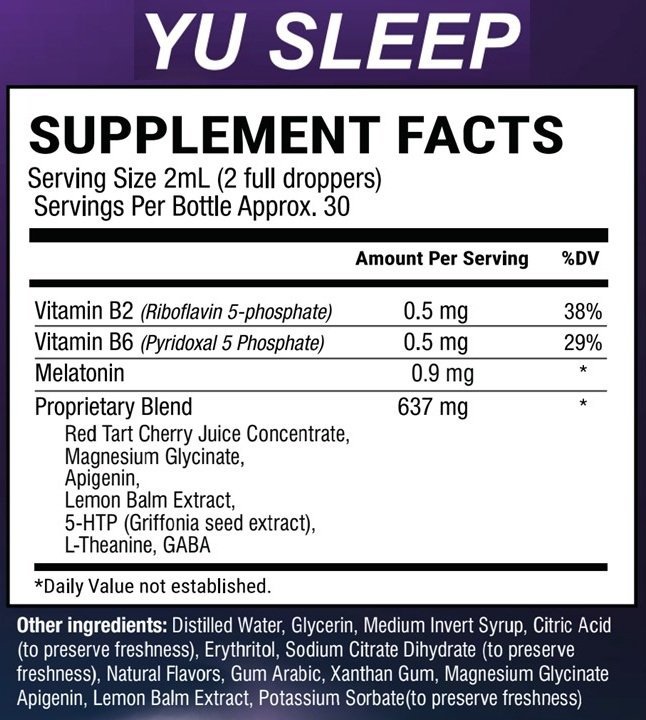
Ingredients that are not in Yu Sleep but are sometimes used for sleep include magnesium, glycine, valerian root and chamomile. If one of these has worked for you before, Yu Sleep won't contain it.